A multi-layer intelligence system that detects escalation and ceasefire signals in the Middle East by monitoring aviation, airspace restrictions, route suspensions, and diplomatic movement — before prediction markets price them in.
Platforms like Polymarket price geopolitical outcomes based on the news cycle — analyst commentary, breaking alerts, official statements. But physical signals precede the narrative by hours to weeks. Airlines quietly suspend routes before governments announce airspace closures. Military cargo aircraft surge into a region before operations begin. Diplomatic bizjets cluster at the same airport before talks nobody's reported yet.
The information is public. ADS-B transponder data, NOTAMs, vessel tracking — it's all sitting there. Nobody's converging these independent layers into a single escalation score and comparing it to where prediction markets are pricing the same outcome.
Core thesis: convergence of independent signal layers — aviation, maritime, diplomatic — precedes the news cycle by hours to weeks. The gap between physical reality and market pricing is the edge.
Independent collectors feed into a convergence engine that produces a normalized escalation probability. Each layer watches for different indicators on its own polling interval. The thesis doesn't depend on any single layer being right — it depends on independent signals agreeing.
Each layer monitors a different class of physical indicator. The power isn't in any single layer — it's in what happens when they converge.
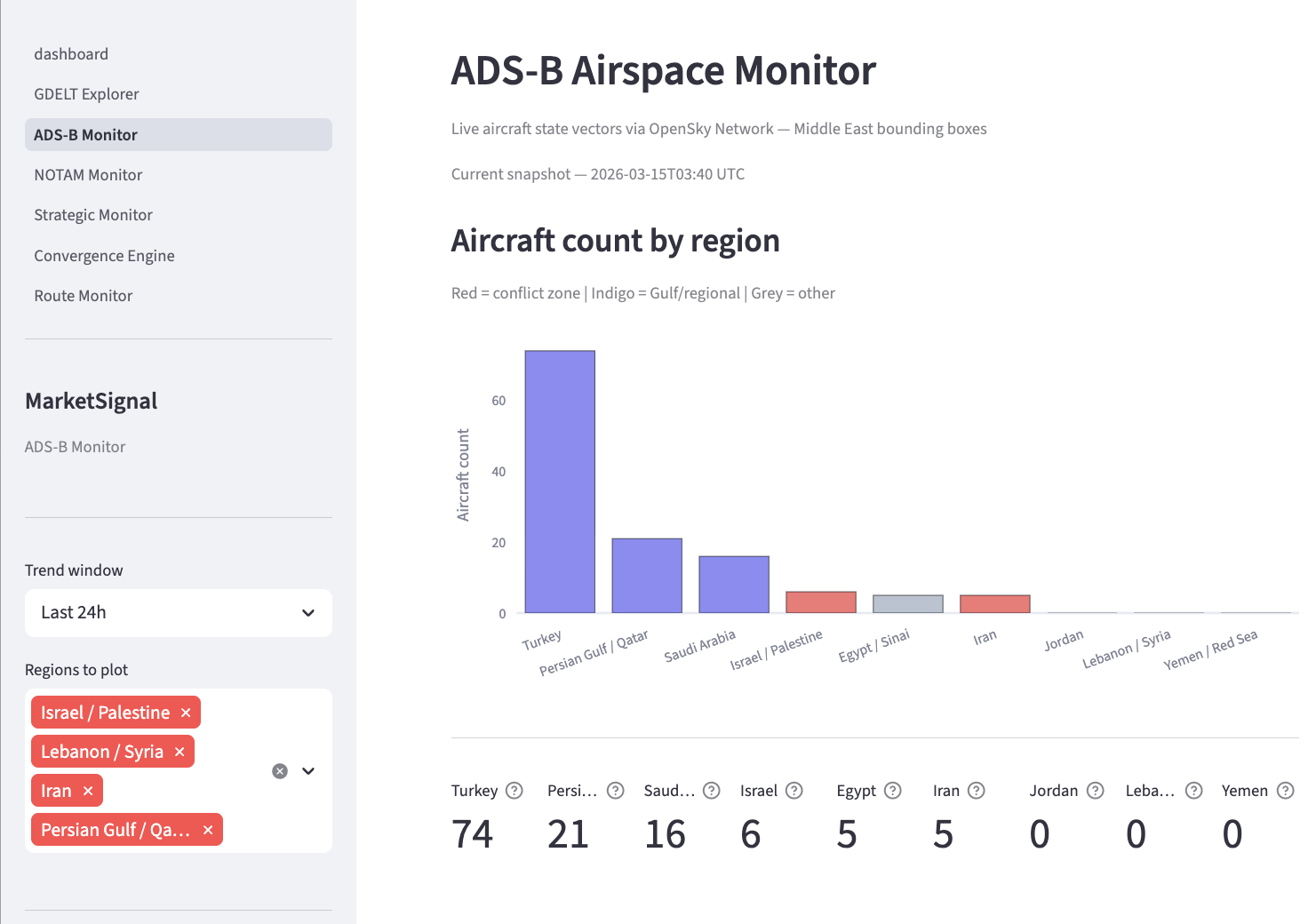
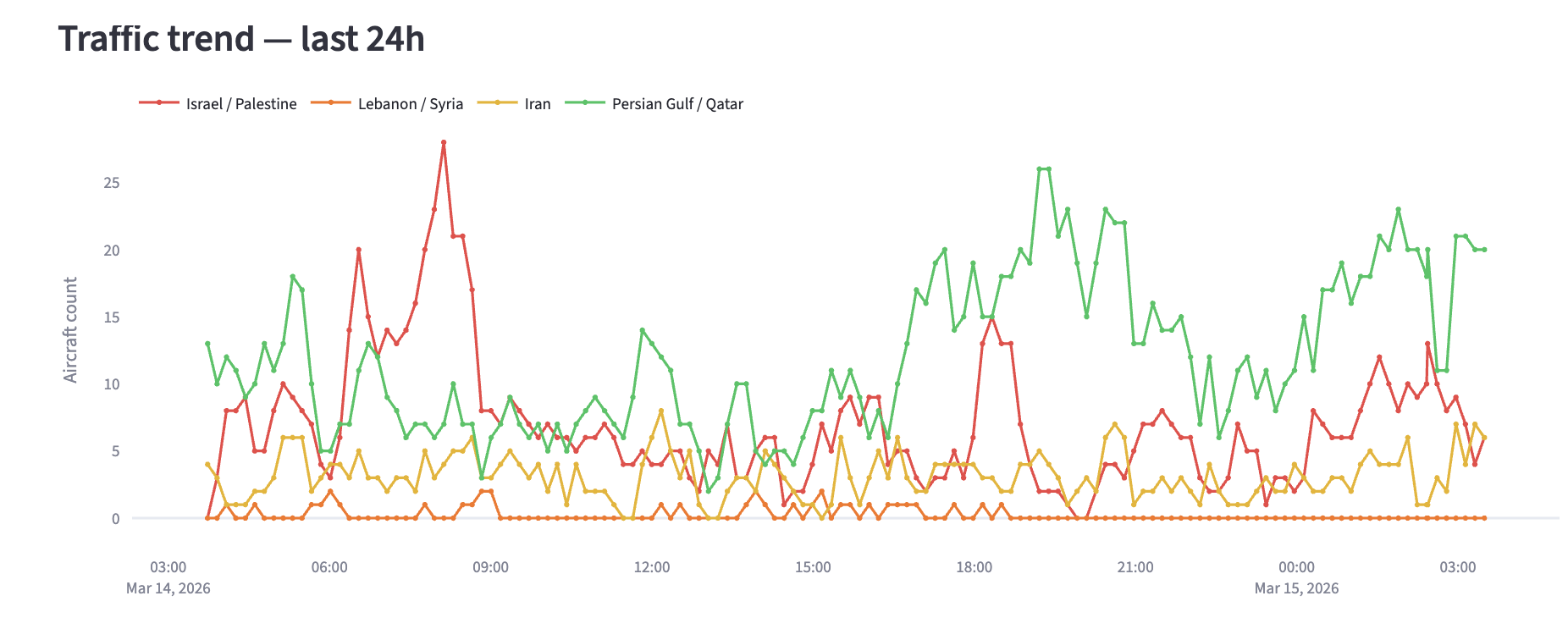
Tracks 13 airlines across 9 Middle East bounding boxes every 10 minutes. Flags anomalies when aircraft counts drop 40%+ against a 7-day same-hour, same-day-of-week baseline. Airlines know before governments announce.
49 government and military aircraft on a VIP watchlist — E-4B Doomsday planes to Gulf royal flights. Tracks sightings, going-dark events, and strategic type surges across four watch regions.
NOTAMs are filed hours before kinetic events. The system polls for Middle East restriction filings every 30 minutes, auto-flags restriction Q-codes, and preserves first-detection timestamps for back-testing lead times.
Compares scheduled vs. actually operated flights across all monitored airport pairs. When airlines quietly drop service — operated flights falling 60%+ below schedule for 3 consecutive days — that's a leading indicator.
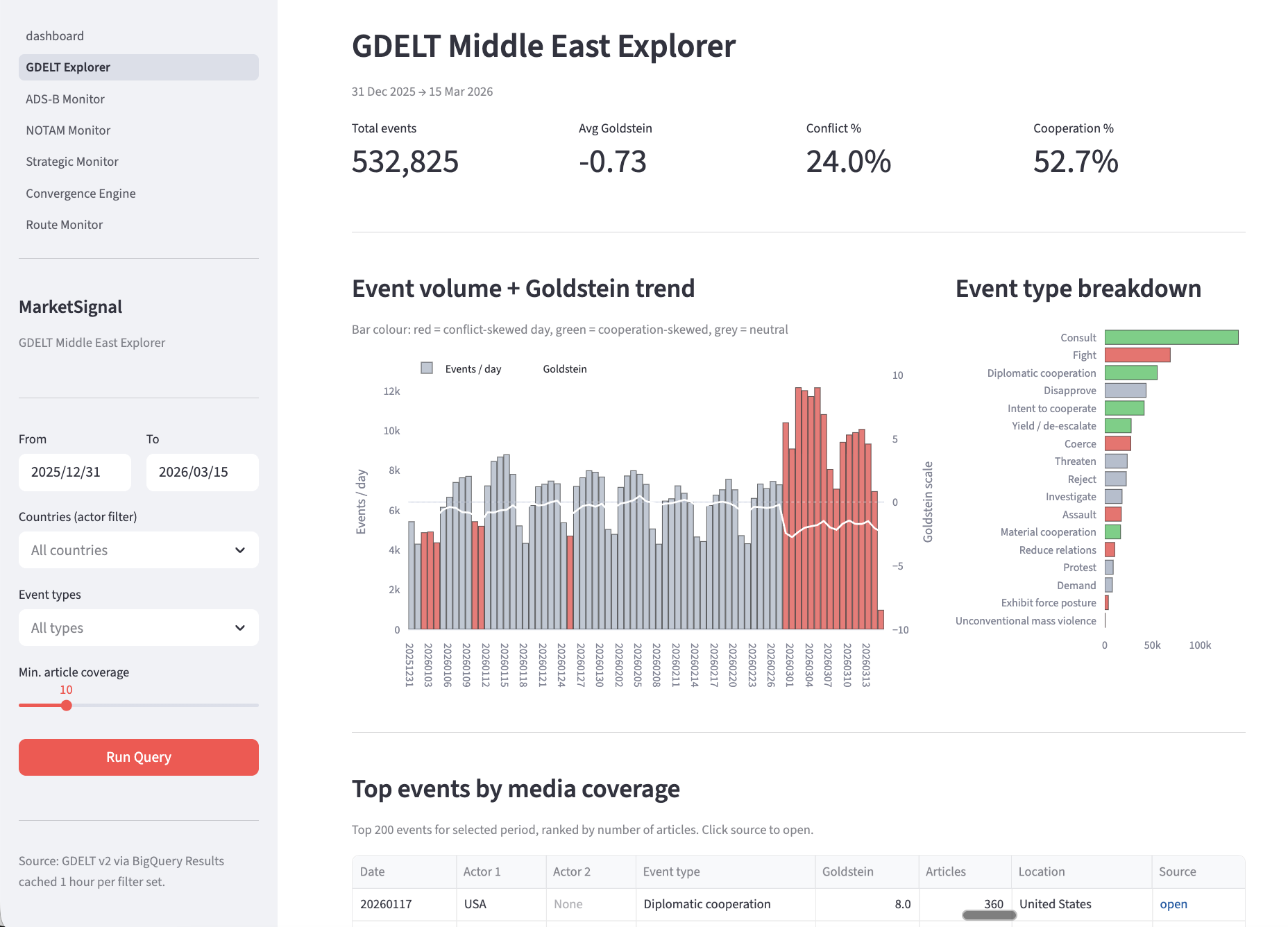
2.5 million geopolitical events since January 2023. The Goldstein scale separates escalation from ceasefire, giving the convergence engine a historical baseline — and a divergence detector when physical signals contradict the diplomatic narrative.
Carrier strike group positioning, tanker rerouting away from Hormuz, and supply ship tracking. Includes velocity anomaly detection to filter the 600+ daily GPS spoofing events in the Hormuz corridor.
Every 10 minutes the engine reads all signal tables, applies decay and growth functions, weights each active signal, checks for cross-layer coherence, and outputs a normalized 0–1 escalation probability.
The critical design decision: distinguishing events from states. A VIP sighting is an event — it happened, significance decays. An ISR aircraft continuously orbiting a region is a state — significance grows the longer it persists, because sustained presence is infrastructure, not a one-off. Getting this wrong means treating a 12-hour E-11A BACN relay the same as a brief diplomatic overflight.
Two decay models, one coherence check, one normalization step.
VIP sightings, type surges, route suspensions. Exponential decay from last_confirmed_at. A diplomatic bizjet sighting matters most in the first hours and fades over days.
ISR on station, active NOTAMs, ADS-B blackouts. Sigmoid growth while active — significance increases the longer the state persists. Exponential decay once resolved.
Fires 1.5× only when 2+ signals in the same region both exceed 2.0. Independent agreement is the thesis — one signal is noise, two is a pattern.
Flags when GDELT diplomatic signals and physical aviation signals point in opposite directions. Disagreement between layers is itself a signal worth surfacing.
The aircraft watchlist, type classifications, and anomaly thresholds weren't pulled from a Wikipedia article. They were developed in collaboration with a veteran aircraft broker with over two decades of industry experience — someone who understands which airframes move for which reasons, what "normal" looks like for military logistics versus diplomatic shuttles, and which patterns actually precede geopolitical events versus routine exercises.
This is the difference between building a tool that tracks planes and building a tool that understands what the planes mean.
A single $6/month VPS running systemd services. The complexity is in the signal logic, not the architecture. Every collector writes to local SQLite, the convergence engine reads from all of them, and Streamlit surfaces the results. No Kubernetes. No microservices. Just Python, SQL, and a thesis.
I find the signals hiding in your workflow and build the system that surfaces them. Let's talk about what's slowing you down.
Book a discovery call